


If you're thinking about moving to Cape Coral, you probably have the same ten questions everyone else does. I went through the local Facebook groups and pulled out the ones people ask the most, then answered each one with actual numbers instead of opinions.
One of them can add more than $30,000 to the cost of a home, and most people don't think to ask it until after they've bought. That's question 9.
I've been in real estate since 2014, I live on the water here, and I've been through a major hurricane in this city. Answering these exact questions for people moving from out of state is what we do every day.
What's it actually like to live in Cape Coral?
Cape Coral is quiet, spread out and built around the water. It's one of the largest cities in Florida by land area, but it doesn't feel like a big city, because almost all of that space is neighborhoods.
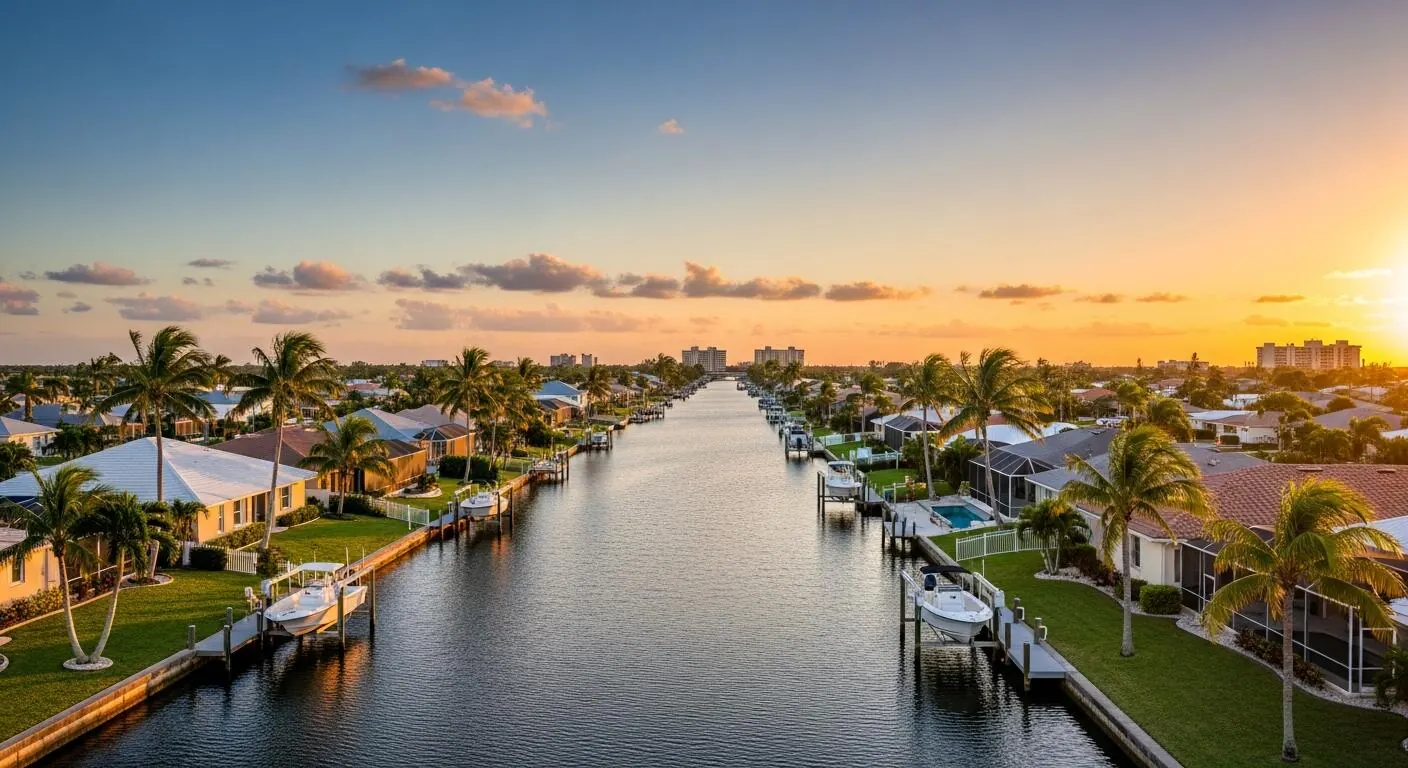
Picture miles of single-family homes along canals, with shopping and restaurants clustered on a few main roads like Del Prado and Pine Island Road. There's no skyline and no dense downtown core, so you'll drive to just about everything. If you're coming from the suburbs, it'll feel familiar, just with palm trees and a lot more water.
The energy is on the south end. Downtown Cape Coral on SE 47th Terrace has the restaurants, breweries, live music and most of the city's events. Head north and things get quieter and more spread out, and that's also where a lot of the new construction is going up.
Where the Cape really shines is your time off. Weekends here revolve around the water: the boat out to a sandbar, fishing off your own dock after dinner, kayaking the mangroves at Four Mile Cove. When you want something bigger, Fort Myers is right across the river.
So yes, it's quiet, and for most people who move here that's the whole point. You're trading nightlife for space, water and a slower pace. If that trade sounds good, there's a really good chance you'll love it here. If it doesn't, better to know now. Our Cape Coral vs. Fort Myers comparison can help if you're torn.
Is there an HOA in Cape Coral?
For most of the city, no. The majority of Cape Coral is individual lots in regular neighborhoods with no HOA, no monthly dues and no board. The exceptions are newer planned communities and some gated neighborhoods, so if you're looking at one of those, read the rules before you buy.
Here's the part that surprises people. Even without an HOA, the city has its own code, and it covers a lot of what an HOA normally would. Grass has to stay under 12 inches, you can't park on the lawn, and trash cans need to be out of view from the street between pickup days.
Enforcement is mostly complaint-driven. If a neighbor reports something, you get a notice and time to fix it, and for most people that's the end of it. Where people get into trouble is ignoring those notices, because fines add up, and the city removed its cap on code fines in 2025.
So most of Cape Coral has no HOA, but it does have a standard. That consistency is a big part of why neighborhoods here look cared for.
Does Cape Coral have beaches?
Not really, at least not the white sand Gulf beaches you're picturing. Cape Coral sits on the Caloosahatchee River, not the open Gulf.
There's a small public beach on the river at the Yacht Club, and it's a nice spot for sunset, but it isn't a Gulf beach (and the rest of the park is mid-rebuild around it right now). For the real thing, most people head to Fort Myers Beach or over the causeway to Sanibel, usually somewhere around 30 to 45 minutes depending on where you live in the Cape.
What Cape Coral has instead is water everywhere. More than 400 miles of canals, and thousands of homes with a dock in the backyard. So instead of fighting for beach parking, a lot of locals take the boat out to a sandbar or to islands like Cayo Costa that you can really only reach by water. Here, the beach is usually a boat ride, not a car ride.
If walking to the beach every morning is the goal, the Cape probably isn't it. If living on the water with the Gulf as your weekend playground is the goal, that's exactly what this city was built for. More on how the canals work in the relocation guide.
Are there alligators in the canals?
Sometimes, but it depends a lot on which kind of canal. Cape Coral has two kinds. Saltwater canals connect to the river and out to the Gulf, and those are the ones boaters want. Freshwater canals connect to inland lakes and don't reach open water.
Alligators prefer fresh water, so you're much more likely to see one in a freshwater canal or lake than behind a home on the saltwater side. This is still Florida, so never say never, but on the saltwater canals it's pretty rare.
If you end up near fresh water, it mostly comes down to common sense. Watch small pets near the water's edge, especially around dawn and dusk, and never feed a gator, which is illegal in Florida. If one gets too comfortable in your yard, you don't handle it yourself. Call the state's nuisance alligator hotline at 866-FWC-GATOR and a licensed trapper will take care of it.
Honestly, once people live here a while, gators stop being the wildlife they talk about. It's the manatees floating past the dock, the dolphins following the boat, and the burrowing owls living right in the neighborhoods.
How often do hurricanes actually hit Cape Coral?
Less often than the news makes it feel. Lee County has had two direct hurricane landfalls in about 22 years: Charley in 2004 and Ian in 2022. Between Wilma in 2005 and Irma in 2017, Southwest Florida went roughly 12 years without a significant storm.
That doesn't mean storms that land somewhere else can't affect us. Helene and Milton both came ashore well north of here in 2024, and both still caused flooding in parts of the city. So hurricanes are a real part of life here, just not the every-summer event people imagine.
In real life, hurricane season runs June through November, and most of it passes quietly. Locals watch the tropics, keep a few supplies on hand and know their plan. A lot of Cape Coral's housing is newer and built to Florida's modern building codes, which were strengthened after Hurricane Andrew. And the single most useful thing you can know about any home here is its elevation, because that tells you more about flood risk than almost anything else.
Living here doesn't mean living in fear of storms. It means respecting them. Our hurricane prep page covers the plan side.
How much is home insurance in Cape Coral?
It's a range, and the house itself decides where you land in it. Depending on the source and the home, Cape Coral homeowners insurance averages anywhere from about $3,000 a year to around $8,000 or $9,000.
A newer home with a newer roof and impact windows tends to sit at the lower end. An older home with an older roof, especially on the water, tends to sit at the higher end. The encouraging news is that the market has started to loosen up. Citizens, the state-backed insurer, moved to cut its average rates for 2026, and new insurance companies have been coming back into Florida.
Flood insurance is a separate policy, and this is where people get the most confused, because there's no single number for the whole city. Your flood premium depends on the home's flood zone and elevation, and those can change from one street to the next. A new home built above the required flood elevation can pay dramatically less than an older home a block away. Cape Coral also participates in a FEMA program that gives homeowners an automatic 25 percent discount on federal flood policies.
My best advice: get insurance quotes before you write an offer, not after, so that number is part of your decision instead of a surprise at closing. The relocation guide walks through what to ask about any home, from flood zone to city water, and the cost to own calculator helps you put the whole monthly picture together.
Can I find a job in Cape Coral?
Yes, but plan for it before you move. As of August 2026, Lee County's unemployment rate was 5.2 percent, up about half a point from a year earlier. That isn't a crisis, but it's not the help-wanted-sign-in-every-window market of a few years ago either.
A big share of the local economy is healthcare, construction and hospitality, so that's where most of the openings are. What people don't hear about is how seasonal the work can be, especially in restaurants. From about January through April, when winter residents are here, businesses are busy and hiring. By late summer, things slow down and hours get cut. Move down in July expecting February's shifts and that first summer can be rough.
So line up a job, or bring remote income with you, before you make the move. It's the difference between enjoying your first slow season and stressing through it.
What part of Cape Coral should I live in?
The answer comes down to four physical things about the home, not a neighborhood name. Fair housing laws mean I don't steer anyone toward or away from areas based on who lives there, and honestly, that isn't the best way to choose a home here anyway.
- Flood zone and elevation. This affects your insurance more than almost anything else.
- Utilities. Some areas have city water and sewer, others are still on well and septic.
- The water. Gulf access, a freshwater canal, or not on the water at all. Each is a different lifestyle and a different price.
- Your commute. Cape Coral covers a lot of ground. If you'll work in Fort Myers, living near the bridges instead of up in the north end saves real time every day.
Once you know your answers, the right areas narrow themselves down fast. Our neighborhoods page breaks down all four quadrants of the city with our favorite spots in each.
What is the UEP assessment in Cape Coral?
The UEP is the city's Utilities Extension Project, and it's the $30,000 question. Large parts of north Cape Coral were built on private wells and septic tanks. The city has been bringing water, sewer and irrigation lines into those neighborhoods, and it pays for it with a special assessment on every property that gets the new service.
Here's a real example. The most recent area approved is North 1 East. The estimated assessment for a standard single-family lot there is $32,288. Most owners finance it over 30 years, which works out to about $3,385 a year on the property tax bill, and billing starts this November.
The next area, North 3, covers almost 59 road miles in northwest Cape Coral with a projected cost of more than $384 million. City council paused it in October 2026 for a redesign, so the final assessment amounts for those homeowners still aren't set.
Why this matters when you buy: the assessment stays with the property, not the owner. Buy in an area that's already been assessed and you may be taking over the remaining balance. Buy in an area that hasn't been assessed yet and it's likely coming, so you want a rough idea of when and how much. Either way, it belongs in the number you offer.
Anytime we help someone make an offer north of Pine Island Road, we check exactly where that property stands with the UEP before a number goes on paper. If you're looking up there and want us to look into a specific home with you, book a quick call.
None of this is hidden. It just isn't easy to find unless you know to look.
Is moving to Cape Coral worth it?
For someone who comes in knowing everything above, I really believe it is. But here's the honest version, no realtor spin.
The trade-offs are real. Insurance will probably cost more than you're used to. You'll watch the tropics every summer and fall. Depending on where you buy, there may be a utility assessment in your future. The city enforces its standards for how homes are kept up. Work can slow down in the off-season, and you'll drive to most places you go.
On the other side: Florida has no state income tax. You can live on a canal with a straight shot to the Gulf and spend your weekends on the water instead of just visiting it on vacation. A lot of the housing is newer, and the city is still investing in roads and utilities as it grows. And watching the sunset from your own dock on a random Tuesday never really gets old.
The people who end up unhappy here usually aren't unhappy with the city. They're caught off guard by things they didn't know before they moved. And now you know them. If you'd like all of this in one place, the relocation guide is free.